
Have you ever noticed how a familiar song can instantly transport you back to a specific moment in time? Perhaps it's a melody from your wedding day, a tune that played during a memorable road trip, or a lullaby your grandmother used to sing. This remarkable connection between music and memory isn't just sentimental—it's deeply rooted in neuroscience.
Recent studies have revealed that learning to play a musical instrument, particularly the piano, can have profound effects on cognitive function and memory retention, especially as we age. And the best part? It's never too late to start.
Did you know? Research from Northwestern University found that musicians have enhanced neural processing that helps them better retain information and resist cognitive decline.
The Science Behind Music and Memory
When we play music, our brains light up like a fireworks display. Unlike passive listening, actively playing an instrument engages nearly every area of the brain simultaneously—particularly the visual, auditory, and motor cortices. This full-brain workout strengthens the neural pathways responsible for memory, attention, and problem-solving.
Dr. Sarah Chen, a neuroscientist at Stanford University, explains: "Playing piano requires the simultaneous coordination of both hands, reading musical notation, listening to the output, and making real-time adjustments. This multi-sensory engagement creates stronger memory traces than almost any other activity."
Ready to experience these benefits yourself?
Discover the Easiest Way to Learn Piano →Join over 500,000 students who've transformed their lives through piano
Why Piano is the Ideal Instrument for Cognitive Health
While any musical instrument can provide cognitive benefits, the piano offers unique advantages that make it particularly effective for brain health:
- Bilateral coordination: Playing piano requires independent use of both hands, which strengthens the connection between the brain's hemispheres
- Visual-spatial processing: Reading sheet music and translating it to finger movements enhances spatial reasoning abilities
- Immediate feedback: You instantly hear whether you've played correctly, creating a powerful learning loop
- Accessibility: Unlike wind instruments, you can start making pleasant sounds from day one
It's Never Too Late to Start
One of the most exciting findings from recent research is that the brain's plasticity—its ability to form new neural connections—continues well into our senior years. This means that even if you've never touched a piano before, you can still reap significant cognitive benefits by starting now.
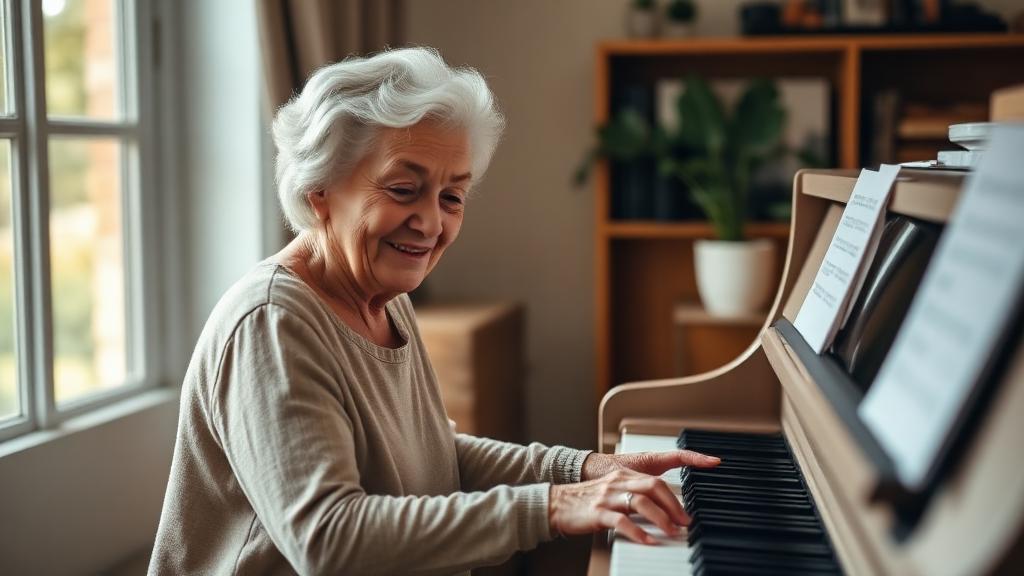
Take Barbara, a 74-year-old retiree from Florida who started learning piano two years ago: "I was always told I wasn't musical, so I never tried. But after reading about the memory benefits, I decided to give it a shot. Within just a few months, I noticed I was remembering names better and felt more mentally sharp overall. Plus, I can actually play songs now—it's been one of the most rewarding experiences of my life."
The Modern Approach to Learning Piano
Traditional piano lessons often focus heavily on reading sheet music, which can be frustrating and slow for adult learners. However, modern methods have revolutionized how people learn piano.
One innovative program uses a "play-by-ear" approach that prioritizes rhythm and chords over complex notation. This allows beginners to sound like pros within days, not years—building confidence and keeping the brain engaged with constant progress.
Learn More About This Method →How Music Helps Preserve Memories
The relationship between music and memory is bidirectional. Not only does playing music strengthen our general cognitive abilities, but music can also serve as a powerful trigger for specific memories.
This is why music therapy has become increasingly popular in treating Alzheimer's disease and dementia. Even patients with severe memory impairment often respond to familiar melodies, sometimes singing along to songs they haven't heard in decades. The emotional centers of the brain, where music is processed, remain relatively preserved even as other functions decline.
The Therapeutic Benefits of Daily Piano Practice
Beyond cognitive benefits, regular piano practice offers significant mental health advantages:
- Stress reduction: Playing music lowers cortisol levels and promotes relaxation
- Emotional expression: Music provides an outlet for processing complex feelings
- Sense of accomplishment: Mastering new pieces builds confidence and self-esteem
- Social connection: Music brings people together, reducing isolation
- Mindfulness: Focused practice keeps you present and engaged
Research shows that just 20-30 minutes of daily practice can produce measurable improvements in memory and cognitive function within weeks.
Start Your Musical Journey Today
Imagine being able to sit down at a piano and just PLAY—Ballads, Pop, Blues, Jazz, and even Classical pieces. With the right method, you can learn in months, not years.
🎹 Discover the Pianoforall Method →Trusted by over 500,000 students worldwide • Learn at your own pace • Works on any device
Getting Started: What You Need to Know
If you're inspired to begin your piano journey, here are some practical tips to get started:
1. You don't need an expensive piano. A simple keyboard with 61 keys is sufficient for beginners. Many excellent models are available for under $200.
2. Choose the right learning method. Traditional lessons can be expensive and slow. Modern online piano courses offer a more flexible, affordable, and often faster path to playing real music.
3. Be consistent. Short, daily practice sessions are more effective than long, sporadic ones. Even 15-20 minutes per day can yield impressive results.
4. Enjoy the journey. Focus on playing music you love. The more you enjoy practice, the more you'll do it, and the greater the cognitive benefits you'll receive.
Conclusion: The Gift That Keeps on Giving
Learning to play piano is more than just acquiring a new skill—it's an investment in your brain health and overall well-being. The therapeutic power of music has been recognized for centuries, and modern science is finally catching up to explain why.
Whether you're 25 or 75, there's no better time to start than now. The connections you'll build—both neural and social—will enrich your life in ways you never imagined.
As the saying goes: "The best time to plant a tree was 20 years ago. The second best time is now." The same applies to learning piano.
Ready to Transform Your Life Through Music?
Join over half a million students who've discovered the joy of playing piano—and the cognitive benefits that come with it.
🎹 Start Learning Piano Today →Instant access • Works on any device • 60-day money-back guarantee